


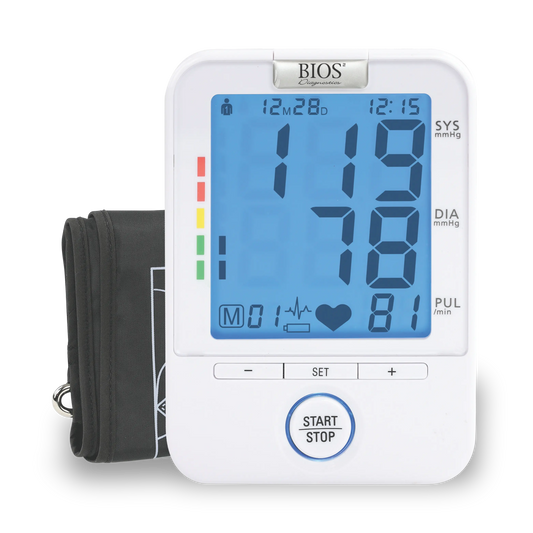
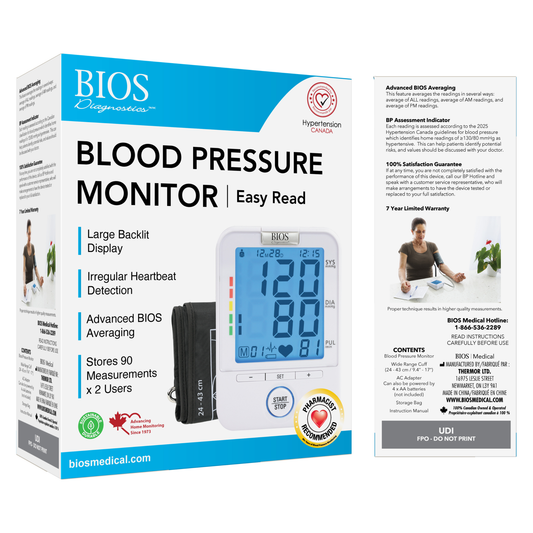

Que vous gériez une maladie chronique ou que vous surveilliez simplement vos chiffres, l’utilisation correcte d’un brassard de tension artérielle est importante pour obtenir des mesures précises. Voici des informations précieuses sur la façon d’utiliser correctement un brassard de tensiomètre automatique, comment choisir le bon brassard, et plus encore.
Qu’est-ce qu’un brassard de tensiomètre et comment fonctionne-t-il?
Un brassard de tensiomètre fait partie d’un appareil utilisé pour mesurer la tension artérielle, un indicateur vital de la santé cardiovasculaire. Il se compose d’une bande qui s’enroule autour du haut de votre bras et d’un tube qui se connecte au tensiomètre. Il se gonfle pour restreindre temporairement le flux sanguin. Pendant le gonflage, les capteurs du brassard détectent la force exercée par votre sang sur les parois artérielles, mesurant deux chiffres clés:
● Pression systolique : la pression lorsque votre cœur bat.
● Pression diastolique : la pression lorsque votre cœur est au repos entre les battements.
Les brassards de tension artérielle sont utilisés avec des tensiomètres manuels et automatiques. Alors que les appareils manuels nécessitent un stéthoscope et une certaine habileté de l’utilisateur pour interpréter les lectures, les modèles automatiques utilisent des capteurs pour afficher les résultats numériquement, ce qui les rend plus faciles à utiliser, beaucoup plus précis et idéaux pour un usage domestique.
Comment choisir le bon brassard de tensiomètre?
Mesurez votre bras : Utilisez un ruban à mesurer pour déterminer la circonférence de votre bras. Cela vous aidera à choisir la bonne taille de brassard, qu’il s’agisse d’une petite, d’une large ou d’une très grande taille.
Faites correspondre votre appareil : Assurez-vous que le brassard est compatible avec votre moniteur. Certains brassards sont spécialement conçus pour les appareils automatiques, tandis que d’autres sont destinés aux moniteurs manuels.
Options spécialisées : Considérez les brassards adaptés à des besoins spécifiques, tels que les brassards rigides qui facilitent l’application.
Quelles sont les erreurs les plus courantes lors de l’utilisation d’un brassard de tension artérielle?
Même un brassard de haute qualité ne donnera pas de lectures précises s’il est utilisé de manière incorrecte. Évitez ces erreurs courantes:
● Placement incorrect : Positionnez le brassard sur le haut du bras, à environ un pouce au-dessus du coude. Le placer trop haut ou trop bas peut fausser les résultats.
● Position incorrecte du bras : Le brassard doit être au niveau du cœur, et votre bras soutenu pendant la lecture (si nécessaire). Le laisser pendre ou reposer trop bas peut entraîner des lectures plus élevées.
● Mouvement : Restez immobile pendant la prise de mesure. Bouger ou parler peut interférer avec les capteurs du brassard.
● Ajustement du brassard : Assurez-vous que le brassard est bien ajusté, mais pas trop serré. Un brassard lâche ou trop serré peut fausser les résultats et entraîner des mesures incohérentes.
Conseils pour obtenir les lectures de tension artérielle les plus précises
Préparez-vous à l’avance
Évitez les activités qui pourraient augmenter votre tension artérielle au-dessus de vos niveaux moyens avant de prendre une mesure.
Utilisez la période de repos
Asseyez-vous tranquillement pendant 5 à 10 minutes avant de prendre une mesure afin de permettre à votre corps de revenir à un état de référence.
Choisissez le bon moment
Prenez votre tension artérielle à des heures régulières chaque jour, par exemple le matin avant le petit-déjeuner ou le soir avant de vous coucher, afin de suivre les tendances avec précision.

Maintenez une posture correcte
Asseyez-vous sur une chaise, le dos appuyé et les deux pieds à plat sur le sol. Assurez-vous que votre bras est soutenu et au niveau du cœur.
Effectuez plusieurs lectures
Pour obtenir le résultat le plus fiable, prenez deux ou trois mesures à une minute d’intervalle et calculez la moyenne. Cela permet de tenir compte des légères fluctuations.
Comment entretenir votre brassard de tensiomètre
● Inspectez régulièrement : Vérifiez les signes d’usure, tels que les bords effilochés, le Velcro usé ou les tuyaux endommagés.
● Nettoyez soigneusement : Essuyez le brassard avec un chiffon humide pour le maintenir hygiénique. Évitez de l’immerger dans l’eau, ce qui pourrait endommager les composants internes.
● Rangez correctement : Gardez le brassard dans un endroit frais et sec, à l’abri de la lumière directe du soleil ou de l’humidité excessive. Cela aidera à préserver les matériaux et à prévenir la dégradation.
Signes qu’il est temps de remplacer votre brassard de tensiomètre
Avec le temps, l’usure peut affecter les performances de votre brassard de tensiomètre. Surveillez ces signes avant-coureurs qu’il est temps de le remplacer:
● Lectures incohérentes : Si vos résultats fluctuent sans explication, le brassard pourrait ne plus fonctionner correctement.
● Dommages visibles : Un tube fissuré, un tissu effiloché ou des problèmes de gonflage sont des indicateurs clairs d’usure.
● Problèmes de Velcro : Un brassard qui ne reste pas bien attaché pourrait ne pas se gonfler uniformément, ce qui compromet la précision.
Si votre brassard présente l’un de ces signes, il est préférable de le remplacer rapidement pour maintenir une surveillance fiable de la tension artérielle.
Achetez des brassards de tensiomètre automatique et plus encore chez BIOS Medical
Pour des brassards de tensiomètre automatique de haute qualité et fiables, commencez par faire vos achats chez BIOS Medical. Avec une gamme de tailles et de modèles conçus pour la précision et la commodité, BIOS Medical peut vous aider à surveiller efficacement votre santé. Que vous ayez besoin d’un brassard de remplacement ou d’une mise à niveau de votre système actuel, leurs produits sont conçus pour soutenir votre parcours de bien-être.
Une surveillance précise de la tension artérielle commence par les bons outils et une technique appropriée. Grâce aux conseils fournis dans cet article, vous pouvez vous assurer d’obtenir les lectures les plus fiables à chaque fois. Pour plus d’informations ou pour parcourir les options disponibles, achetez en ligne chez BIOS Medical dès aujourd’hui.
FAQ :
Quelle est la bonne façon de porter un brassard de tension artérielle?
Un brassard de tension artérielle doit être placé sur le haut du bras, à environ un pouce au-dessus du coude. Le brassard doit être bien ajusté sans être trop serré, et votre bras doit rester positionné avec le brassard au niveau du cœur pendant la lecture.
Quelle doit être la fermeté d’un brassard de tensiomètre?
Un brassard de tensiomètre doit être suffisamment serré pour rester en place tout en vous permettant de glisser un ou deux doigts en dessous. Un brassard trop serré ou trop lâche peut affecter la précision.
Pourquoi mes mesures de tension artérielle sont-elles différentes à chaque fois?
Les lectures de tension artérielle peuvent varier en raison des mouvements, du stress, de la conversation, d’un mauvais placement du brassard, de la consommation de caféine ou de la prise de mesures à différents moments de la journée. Prendre plusieurs lectures et en faire la moyenne peut améliorer la cohérence.
L’utilisation d’un brassard de mauvaise taille peut-elle affecter les lectures de tension artérielle?
Oui, l’utilisation d’un brassard de mauvaise taille peut entraîner des lectures inexactes. Un brassard trop petit peut donner des lectures plus élevées, tandis qu’un brassard trop grand peut donner des lectures plus basses.
À quelle fréquence faut-il remplacer un brassard de tensiomètre?
Un brassard de tensiomètre doit être remplacé s’il présente des signes d’usure, tels que des tubes fissurés, un Velcro usé, des lectures incohérentes ou des problèmes de gonflage.
Découvrez les produits connexes ici :
- https://biosmedical.com/products/replacement-cuffs-for-bd244
- https://biosmedical.com/products/wide-range-replacement-cuff
- https://biosmedical.com/products/replacement-cuffs-for-bd204
- https://biosmedical.com/products/replacement-cuff-for-3al1-3e
- https://biosmedical.com/products/replacement-cuff-for-3ms1-4y


